1. When the Weight of Failure Feels Unbearable
You know that feeling — the one that hits you at 2 a.m. when the house is quiet and your thoughts get loud. The replaying of every wrong decision, every broken promise, every moment you let someone down, including yourself. Maybe it was a marriage that crumbled. A business that collapsed. A sin you swore you’d never commit again. A child you failed to protect. A dream that slipped through your fingers no matter how hard you held on.
And somewhere in the middle of all that noise, a quiet but crushing voice whispers: “You are a failure.”
That voice feels so convincing, doesn’t it? It speaks with such authority. It points to the evidence — the broken relationship, the unpaid bills, the empty seat at the dinner table — and it says, “See? This is who you are. This is all you’ll ever be.”
But here’s what I need you to know before we go any further: that voice is not God’s voice.
God’s voice sounds completely different. It speaks of mercy that is new every morning. It speaks of a future and a hope. It speaks of beauty rising from ashes. It speaks of a Savior who specifically came for the broken, the lost, and the ones who’ve already failed more times than they can count.
If you’ve been searching for Bible verses for starting over after failure, you’ve come to the right place. Not for a quick feel-good quote to slap on social media, but for real, deep, life-changing truth from the Word of God that can help you actually get back up.
This is for those who are ready to start over — even if they’re terrified. Even if they’ve tried before. Even if they’re not sure they deserve another chance.
Let’s open the Word together.
2. What God Really Thinks About Your Failure
Before we dive into the specific scriptures, we need to settle one thing that trips up so many believers: the difference between what failure means to God and what failure means to the world.
In the world’s economy, failure is final. It goes on your permanent record. It defines your reputation, your credit score, your social standing. The world says: “You had your chance.”
But God operates on a completely different economy. Throughout the entire Bible — from Genesis to Revelation — God’s story is built on people who failed spectacularly and were used mightily anyway.
Moses murdered a man and fled in shame. God made him the deliverer of a nation. David committed adultery and covered it up with murder. God called him a man after His own heart. Peter denied Jesus three times with curses on his lips. Jesus made him the rock on which the church would be built. Paul hunted Christians, watched Stephen being stoned to death, and approved of murder. God made him the most prolific writer of the New Testament.
Failure in the hands of God is not a dead end. It’s often a doorway.
This is not permission to sin or to treat God’s grace like a free pass. It’s a recognition that God is a God of redemption — that His power is most clearly seen not in perfect people, but in restored ones.
The Bible verses for starting over after failure that we’re about to explore aren’t just comforting words. They’re covenantal promises from the God who created you, loves you, and has never once stopped pursuing you — even in your lowest moments.
3. Fifteen Bible Verses for Starting Over After Failure (With Deep Explanations)
Verse 1 — Lamentations 3:22–23 (NIV)
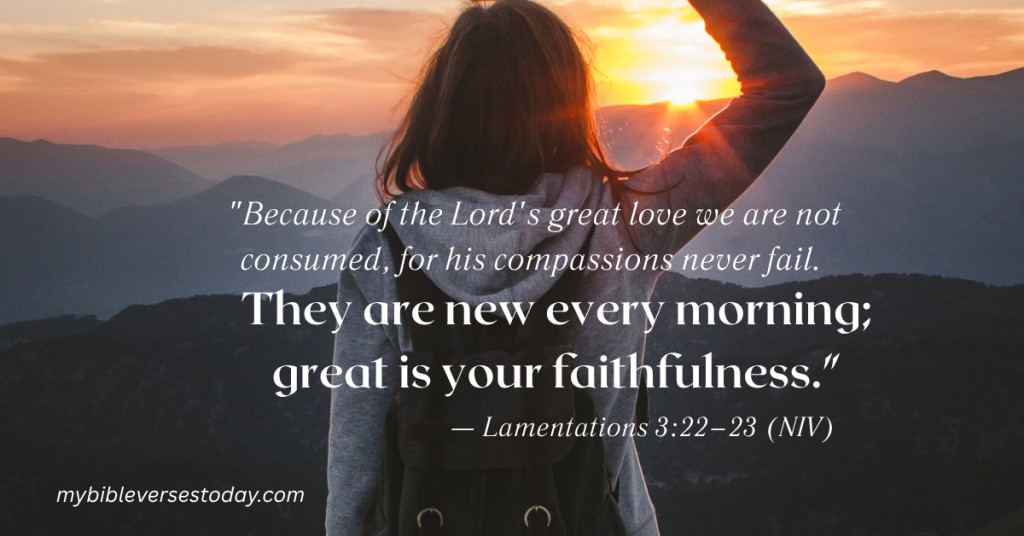
“Because of the Lord’s great love we are not consumed, for his compassions never fail. They are new every morning; great is your faithfulness.”
— Lamentations 3:22–23 (NIV)
What This Means
These two verses come from one of the most emotionally raw books in the entire Bible. Lamentations was written by the prophet Jeremiah in the immediate aftermath of Jerusalem’s destruction — when the city lay in ruins, the temple was burned to the ground, and God’s people had been carried off into captivity. This was not a theoretical suffering. This was devastation at its most complete.
And yet, right in the middle of this unbearable grief, Jeremiah makes one of the most astounding declarations of faith in all of Scripture. He says it is because of the Lord’s great love — His hesed, that deep, covenant, steadfast lovingkindness — that they are not consumed. Not that things are fine. Not that the pain is gone. But that despite everything, God’s compassion has not run out.
The phrase “new every morning” is particularly significant. Every single morning, God’s mercy is not rationed or reduced based on yesterday’s failures. It is fully renewed. You cannot exhaust it. You cannot use it all up. Regardless of what happened yesterday — regardless of how badly you fell — God’s compassions are fresh and available today.
Why This Matters
Many people who struggle with failure carry what theologians sometimes call a “mercy deficit” — the deep fear that they’ve finally used up God’s patience. This verse destroys that fear entirely. God’s compassions are not finite. They are tied to His very nature, which never changes. His faithfulness is described as “great” — not small, not conditional, but vast and reliable.
Real-Life Application
When you wake up tomorrow morning and the weight of yesterday’s failure settles on your chest before you’re even fully awake — before you check your phone, before you get out of bed — let this be your first thought: His mercies are new today. Not recycled. Not leftover. New. Take one minute each morning to say this verse aloud. Let it be the first word you speak into your failure’s narrative.
Verse 2 — Isaiah 43:18–19 (NIV)
“”Forget the former things; do not dwell on the past. See, I am doing a new thing! Now it springs up; do you not perceive it? I am making a way in the wilderness and streams in the wasteland.””
— Isaiah 43:18–19 (NIV)
What This Means
God is speaking to Israel at one of their darkest historical moments — they are a people defined by shame, by captivity, by the memory of better days. And God says something almost shocking: forget the former things. This is not a command to be in denial or to suppress healthy grief. In the Hebrew context, “forget” carries the sense of releasing your death-grip on the past — of not letting it define your forward movement.
What God promises here is remarkable: a “new thing.” Not a patched version of the old thing. Not a slightly improved remix. Something genuinely, fundamentally new. He promises a way in the wilderness — which is an image of impossible provision. Deserts don’t have roads. Wastelands don’t have rivers. But God specializes in making ways where there are none, and bringing life where there is only drought.
This verse is one of the most beloved Bible verses for starting over after failure precisely because it speaks to the geography of hopelessness and declares that God is already working in it.
Why This Matters
Failure often creates a mental wilderness — a place where our thoughts go in circles, where we can’t see any way forward, where everything feels barren. God’s promise here is not that He will remove you from the wilderness instantly, but that He is making a way through it — right now, even if you can’t yet perceive it.
Real-Life Application
Write this verse on a card and put it somewhere you see every day. When your mind starts replaying the old failures, use this verse as a redirect: “Lord, I receive Your new thing. I don’t fully see it yet, but I trust You’re working.” Ask God specifically: “What is the new thing You’re doing in this season?” Then stay open to answers that might surprise you.
Verse 3 — Romans 8:1 (NIV)
“”Therefore, there is now no condemnation for those who are in Christ Jesus.””
— Romans 8:1 (NIV)
What This Means
This single verse might be the most important theological statement about failure and fresh starts in the entire New Testament. Paul writes it at the climax of a passage where he has just finished describing his own internal war with sin — “I do not do the good I want to do, but the evil I do not want to do — this I keep on doing” (Romans 7:19). He sounds like someone who has failed repeatedly.
And then comes Romans 8:1: “no condemnation.” Not “little condemnation.” Not “reduced condemnation for those who try really hard.” None. Zero. For those who are in Christ Jesus — who have placed their faith in Him and are united with Him — the verdict of condemnation has already been struck down. The legal charge against you has been dismissed not because you deserve it, but because Jesus paid for it fully.
Condemnation is what the enemy uses to keep you paralyzed in failure. Conviction from the Holy Spirit leads you to repentance and change. Condemnation just says “you are worthless, you are hopeless, you are done.” Jesus says otherwise.
Why This Matters
This verse matters because so many believers live under a cloud of spiritual condemnation even after they’ve genuinely repented. They confess, they receive forgiveness intellectually, but they continue to punish themselves emotionally. Romans 8:1 is God’s declaration that the punishment is done. The gavel has fallen — in your favor, because of Christ.
Real-Life Application
When the accusing thoughts come — “You should be ashamed, you’ve ruined everything, God is disgusted with you” — answer them with Romans 8:1. Say it out loud: “There is NO condemnation for me in Christ Jesus.” Then ask yourself: Is this the Holy Spirit convicting me toward change, or is this the enemy condemning me toward despair? Spirit conviction leads to life. Condemnation leads to death. Respond to one. Resist the other.
Verse 4 — Psalm 51:10 (NIV)

“”Create in me a pure heart, O God, and renew a steadfast spirit within me.””
— Psalm 51:10 (NIV)
What This Means
This is David’s prayer after his catastrophic moral failure with Bathsheba — arguably the worst chapter in his entire life. He had committed adultery with a married woman, arranged for her husband to be killed in battle, and then tried to cover it up. When the prophet Nathan confronted him, David didn’t minimize or deflect. He went to God in brokenness, and Psalm 51 is the record of that prayer.
The word David uses for “create” is the Hebrew bara — the same word used in Genesis 1 for God’s creative act in making the world from nothing. David wasn’t asking God to spruce up his old heart or give it a polish. He was asking for something brand new to be created where the old, corrupted thing had been. He recognized that starting over required a work only God could do.
“Renew a steadfast spirit” acknowledges that David’s failure had destabilized him spiritually. He needed restoration not just of moral status but of inner consistency — the ability to keep choosing right even when it was hard. This is one of the most honest, humble, and powerful Bible verses for starting over after failure you will ever read.
Why This Matters
Starting over after failure isn’t just about changing behavior. It’s about asking God to do a work at the heart level — because behavior flows from the heart. David knew he couldn’t fix himself. He knew he needed God to reach into the very center of who he was and create something new there.
Real-Life Application
Pray Psalm 51:10 as your own personal prayer. Don’t just recite it — mean it. Say, “Lord, I cannot fix my own heart. I need You to create something clean in me. Renew in me a spirit that stays consistent, that doesn’t drift, that holds fast to You even when temptation comes.” This is not a one-time prayer. Make it part of your daily devotional life, especially in seasons of rebuilding.
Verse 5 — Proverbs 24:16 (NIV)
“”For though the righteous fall seven times, they rise again, but the wicked stumble when calamity strikes.””
— Proverbs 24:16 (NIV)
What This Means
This proverb redefines what it means to be righteous in a way that surprises many Christians. We tend to think the righteous are people who never fall. But Solomon — the wisest man who ever lived — says the righteous are people who fall seven times and still get back up. The number seven in Hebrew literature often denotes completeness or fullness — meaning the righteous can fall completely, repeatedly, and still rise again.
What separates the righteous from the wicked here is not the absence of falling. It is the response to falling. The wicked stumble when calamity strikes and stay down, because they have no spiritual foundation to draw on, no relationship with God to pull them back up. The righteous have a source of strength outside themselves — the living God — who lifts them up again.
This verse is honest about the reality of the Christian life in a way that many churches are not. Failure is not the exception for believers. It is part of the journey. What matters is not that you fell, but that you don’t stay down.
Why This Matters
If you’ve failed multiple times — if you’ve fallen and gotten up and fallen again — this verse speaks directly to you. God is not counting your falls as disqualifications. He is watching to see if you will rise again. Rising again is the evidence of righteousness, not a perfect record.
Real-Life Application
Write this verse in a journal along with a list of the times you have fallen and gotten back up. What you’ll often discover is that you are stronger than you think — that you have been rising for years, even when it felt like you were only falling. Let this become your declaration: “I may have fallen, but I am a person who rises. In God’s strength, I get back up.”
Verse 6 — Joel 2:25 (NIV)
“”I will repay you for the years the locusts have eaten — the great locust and the hopper, the destroyer and the cutter. ‘My great army that I sent among you.'””
— Joel 2:25 (NIV)
What This Means
In its original context, God was speaking to Israel after they had suffered devastating agricultural destruction — literal locusts had devoured their crops, symbolizing the consequences of their spiritual failures and the judgment they’d brought upon themselves. But the promise that follows is staggering: God says He will repay the years that were lost. He will restore what was consumed.
The phrase “the years the locusts have eaten” has become one of the most powerful expressions in Christian vocabulary for describing time that feels wasted by failure, sin, addiction, poor decisions, or painful circumstances. Years of a marriage lived in dysfunction. Years lost to substance abuse. Years spent chasing the wrong things. Years in depression or running from God.
God says: I will restore those years. Not that He will pretend they didn’t happen. Not that He’ll rewind time. But that He is so sovereign, so creative in His redemption, that He can take the years lost to failure and work such transformation and blessing in what remains that it will feel as though those years were never lost at all.
Why This Matters
One of the most painful aspects of failure is the sense of irretrievable loss — the feeling that too much time has been wasted, that you’ve missed your window, that it’s too late. Joel 2:25 is God’s answer to that fear. He is a God who redeems time. He specializes in late-start comebacks.
Real-Life Application
Bring to God in prayer the specific “years the locusts have eaten” in your own life. Name them honestly. Then ask God: “Lord, what does restoration look like for me in this season?” Don’t limit His answer to your own imagination. God’s restoration is often more creative and more beautiful than anything we could have planned ourselves.
Verse 7 — 2 Corinthians 5:17 (NIV)
“”Therefore, if anyone is in Christ, the new creation has come: The old has gone, the new is here!””
— 2 Corinthians 5:17 (NIV)
What This Means
Paul writes to the Corinthian church — a congregation with documented problems including sexual immorality, division, lawsuits between members, and abuse of spiritual gifts. These were not people with a clean record. Yet Paul’s declaration to them is absolute: in Christ, you are a new creation. The old has gone. The new is here.
The Greek word for “new creation” (kaine ktisis) refers not to a renovation but to an entirely new thing — the same creative power God used at the beginning of the world applied to a human being. When you come to Christ, or when you return to Him after failure, you are not the patched-up old version of yourself. You are something genuinely new.
This is one of the most cited Bible verses for starting over after failure for good reason — it is the most fundamental declaration of Christian identity. Your failure does not define you. Your past does not define you. Your identity in Christ defines you, and that identity is new.
Why This Matters
Many people approach God after failure as though they are the same broken person asking for temporary shelter. But the gospel says something far more radical: you are a new being. The old identity — sinner, failure, hopeless case — has passed away. This is not wishful thinking. It is theological reality.
Real-Life Application
Start identifying yourself out loud by what God says you are, not by what your failures say you are. When you introduce yourself to your own thoughts in the morning, say: “I am a new creation in Christ. The old has gone. The new is here.” This is not denial of your past. It is proclamation of your redeemed identity.
Verse 8 — Jeremiah 29:11 (NIV)
“”For I know the plans I have for you,” declares the Lord, “plans to prosper you and not to harm you, plans to give you hope and a future.””
— Jeremiah 29:11 (NIV)
What This Means
This beloved verse is often quoted without its context, which actually makes it even more remarkable when you understand it. God spoke these words to His people in exile — people who were not in the Promised Land but in Babylon, living out the consequences of repeated, generational failure and rebellion. This was not a prosperity gospel message to comfortable believers. It was a hope-restoring word to people in captivity.
God’s plans for them included a future and a hope — but not an immediate escape from their current situation. He told them to build houses, plant gardens, raise families, and seek the peace of the city where they were sent (Jeremiah 29:5–7). God’s plan for them included faithfulness in exile before restoration from it. His “hope and a future” encompassed the journey, not just the destination.
For those searching Bible verses for starting over after failure, this verse offers something profound: God’s good plans for you were not cancelled by your failure. They may have been delayed, redirected, or refined — but they are still active.
Why This Matters
The enemy of your soul wants you to believe that you forfeited God’s plan for your life through your failures. Jeremiah 29:11 says the opposite. God still has plans — specific, intentional, good plans — and they include a hope and a future for you.
Real-Life Application
Read all of Jeremiah 29:4–14 this week to get the full context of this verse. Notice that God’s good plan included being present with His people in the hard middle — not just at the happy ending. Ask God to show you how He is present with you right now, in your current “Babylon,” and what faithfulness looks like in this specific season of starting over.
Verse 9 — Philippians 3:13–14 (NIV)
“”Brothers and sisters, I do not consider myself yet to have taken hold of it. But one thing I do: Forgetting what is behind and straining toward what is ahead, I press on toward the goal to win the prize for which God has called me heavenward in Christ Jesus.””
— Philippians 3:13–14 (NIV)
What This Means
Paul wrote this letter from prison. He had a past that would have disqualified him from ministry in most human institutions — he had been a violent persecutor of the very church he now led. And yet here, he describes the discipline of his own spiritual life: actively forgetting what is behind and pressing toward what is ahead.
“Forgetting what is behind” does not mean emotional suppression or refusing to deal with the past. Paul never pretended his past hadn’t happened — he references it elsewhere in Scripture. It means refusing to allow the past to determine your forward movement. It means not parking in your regret and calling it humility.
“Straining toward what is ahead” uses the image of a runner in a race, leaning forward, every muscle engaged in the pursuit of the finish line. This is not passive. Starting over after failure requires an active, disciplined, forward-focused posture — and Paul models it powerfully here.
Why This Matters
So many believers who have failed get stuck in a spiritual holding pattern — too ashamed to move forward, too guilty to run. Paul’s example shows us that the most qualified people to press forward after failure are sometimes the ones who have fallen the furthest, because they understand most deeply what grace actually cost.
Real-Life Application
Identify one area of your life where you have been spiritually parked because of past failure. What would it look like to lean forward in that area this week? What is one small, concrete step you could take toward the goal God has set before you? Take that step — even if it feels small, even if you feel unworthy. The race is won by those who keep running.
Verse 10 — Micah 7:8 (NIV)
“”Do not gloat over me, my enemy! Though I have fallen, I will rise. Though I sit in darkness, the Lord will be my light.””
— Micah 7:8 (NIV)
What This Means
This is one of the most defiant, courageous declarations of faith in all the Minor Prophets. Micah speaks these words in first person — not as a promise from God, but as a personal declaration of the person who has fallen. Notice he doesn’t deny the fall. He says plainly: “I have fallen.” He doesn’t deny the darkness: “I sit in darkness.” But he refuses to let the fall have the final word.
“I will rise” is not wishful thinking. It is faith-based declaration rooted in the character of God. Micah knows who God is, and because he knows who God is, he can declare with confidence what will happen: he will rise. The enemy who is gloating — who thinks the failure is permanent — is wrong.
“The Lord will be my light” in darkness is a specific promise that God does not abandon His people in their darkest moments. He becomes more present, not less. His light is most visible when the darkness is most complete.
Why This Matters
There are enemies — both spiritual and human — who look at your failure with satisfaction. They’ve counted you out. Micah 7:8 is the biblical grounds for looking those enemies in the face and saying, “You are wrong about me. I am not finished.” Not because of anything in yourself, but because of who God is.
Real-Life Application
Make Micah 7:8 your personal war cry in this season. When the enemy of your soul tells you that you’re done, you’re disqualified, you’re finished — speak this verse out loud with conviction. Write it on your mirror, your phone wallpaper, your journal. “Though I have fallen, I will rise.” Say it until you believe it. Say it until you live it.
Verse 11 — Isaiah 40:31 (NIV)
“”But those who hope in the Lord will renew their strength. They will soar on wings like eagles; they will run and not grow weary, they will walk and not be faint.””
— Isaiah 40:31 (NIV)
What This Means
The Hebrew word translated “hope” here is qavah, which carries the sense of eager, expectant waiting — not passive resignation, but active trust directed toward a specific person. Those who direct their hope toward God — who set their expectation on Him rather than on their own strength or wisdom — receive renewed strength.
The imagery progresses in an interesting way: soaring, then running, then walking. Many commentators note that this is not an ascending hierarchy but a descending one — soaring is glorious, but walking faithfully through the ordinary days without fainting is perhaps the greatest challenge of all. God promises strength for all three phases: the mountaintop moments, the active seasons of running, and the long, slow, faithful plodding through the mundane.
Starting over after failure often requires the “walk and not be faint” kind of strength more than the soaring kind. God promises both.
Why This Matters
Failure is exhausting. The shame, the grief, the rebuilding — it all depletes your emotional and spiritual reserves. This verse speaks directly to that depletion. God is not just the God of grand rescues. He is the God who renews your strength for the ordinary, difficult, daily work of getting back up.
Real-Life Application
Identify where you’re placing your hope. If you’re hoping primarily in your own ability to fix things, your own willpower, other people’s approval, or your circumstances changing — redirect that hope toward God Himself. Spend ten minutes today simply waiting on God in prayer. No agenda, no to-do list. Just presence. This is how hope is renewed.
Verse 12 — 1 John 1:9 (NIV)
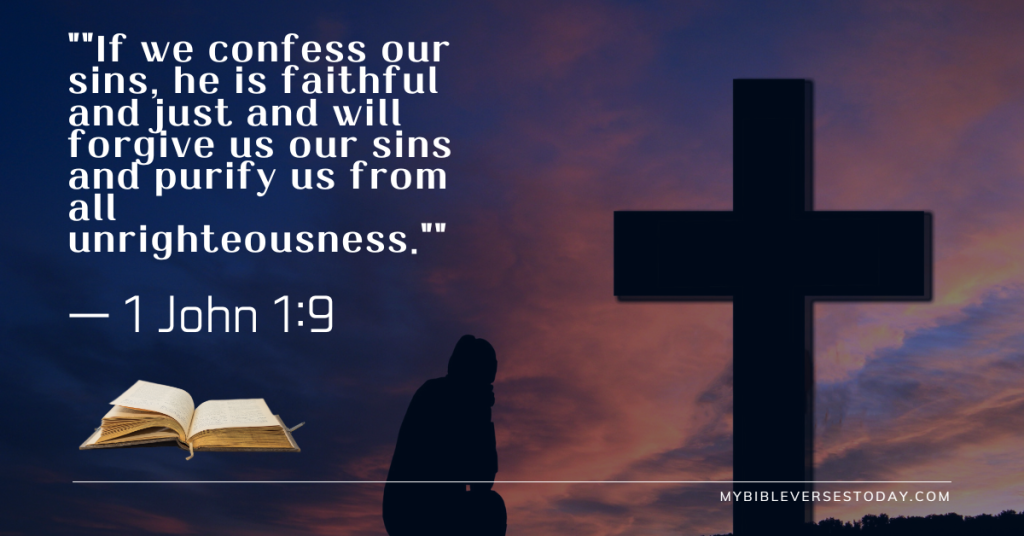
“”If we confess our sins, he is faithful and just and will forgive us our sins and purify us from all unrighteousness.””
— 1 John 1:9 (NIV)
What This Means
John writes to a church dealing with a dangerous heresy that denied the reality of sin — and in doing so, he lays out one of the clearest and most compassionate mechanisms for starting over in the entire New Testament. Confession. The Greek word is homologeo — literally “to say the same thing as,” meaning to agree with God about what happened. Not to minimize, deflect, or reframe your failure, but to call it what He calls it.
When you confess, two things happen: forgiveness and purification. Forgiveness deals with the legal guilt — the charge against you is cleared. Purification deals with the spiritual contamination — the effect that sin has on your soul is cleansed. Both are promised. Both are grounded not in your sincerity but in God’s faithfulness and justice. He is faithful to His promises. And He is just — meaning the cross of Christ has already satisfied the debt, so He can forgive without compromising His holy character.
Why This Matters
Many people who have failed refuse to confess because they believe confession requires them to feel bad enough before God will accept it. But 1 John 1:9 grounds forgiveness in God’s faithfulness — not in the quality of your emotional experience. Honest, simple agreement with God about your failure is all that is required.
Real-Life Application
If there is a failure in your life that you have not fully brought before God — one you’ve been too ashamed to name directly, or one you’ve minimized — take a moment right now to do exactly what 1 John 1:9 describes. Say it plainly. “Lord, I sinned. I did this. I am responsible. I confess it to You.” Then receive — don’t just acknowledge intellectually but actually receive — His forgiveness and purification. You are clean. Walk like it.
Verse 13 — Romans 5:3–5 (NIV)
“”Not only so, but we also glory in our sufferings, because we know that suffering produces perseverance; perseverance, character; and character, hope. And hope does not put us to shame, because God’s love has been poured out into our hearts through the Holy Spirit, who has been given to us.””
— Romans 5:3–5 (NIV)
What This Means
Paul introduces what might be the most countercultural idea in the Bible: glory in suffering. He does not say to be in denial about suffering or to perform positivity. He says to glory — to find a deep, settled sense of meaning — in it. Not because suffering feels good, but because of what it produces in the believer who stays connected to God through it.
The chain is remarkable: suffering produces perseverance. Perseverance, character. Character, hope. This is not a linear, tidy process — it is a forge. The pressure and heat of failure and suffering, when submitted to God, produces something in us that no amount of comfortable living ever could: a character that has been tested and held, and a hope that has been proven trustworthy.
“Hope does not put us to shame” — in the original Greek, this means hope does not disappoint or embarrass us. The hope that God produces through suffering is not naive optimism that evaporates when life gets hard. It is a hope that has been refined through fire and knows it can trust the God who allowed the fire.
Why This Matters
Your failure, submitted to God, is not wasted. The pain you are in right now is doing something in you — producing perseverance, shaping character, building the kind of hope that cannot be shaken. This doesn’t make the pain less real. But it gives it meaning.
Real-Life Application
Ask God to show you what character quality He is building in you through your current suffering or failure. Write it down. Perseverance? Humility? Compassion for others who fail? Deeper dependence on God? Give that character quality a name, and ask God to complete the work He has started in you through this season.
Verse 14 — Ezekiel 36:26 (NIV)
“”I will give you a new heart and put a new spirit in you; I will remove from you your heart of stone and give you a heart of flesh.””
— Ezekiel 36:26 (NIV)
What This Means
God speaks this promise to Israel — a people whose hearts had become hardened through repeated failure and rebellion. A “heart of stone” in biblical imagery represents a heart that has become calloused, unfeeling, unable to respond to God, resistant to change. Many people who have failed repeatedly know this feeling — the numbing that comes from too many falls, too much shame, too many broken promises to yourself and others.
God’s response to the stony heart is not a motivational speech. It is not a to-do list. It is surgery — He removes the old heart and gives a new one. “Heart of flesh” represents a heart that is soft, responsive, capable of feeling God’s presence and responding to His leading again.
This is a promise of deep, internal transformation. Starting over after failure is not just about new circumstances. It requires a new heart. And the extraordinary news of this verse is that God offers to perform that transplant Himself.
Why This Matters
If you feel spiritually numb — if you feel like your heart is hard and you don’t know how to care anymore, how to feel God, how to respond to the things that used to move you spiritually — this verse is for you. You don’t have to soften your own heart. You can’t. But you can ask God to do it, and He promises He will.
Real-Life Application
Pray Ezekiel 36:26 specifically and personally: “Lord, I feel the hardness in my heart. I know what a heart of stone feels like. Please do what only You can do — take this stone heart and replace it with a heart of flesh. Make me responsive to You again. Let me feel Your presence, hear Your voice, and move in Your direction.” Pray it daily until you begin to feel the thaw.
Verse 15 — Revelation 21:5 (NIV)
“”He who was seated on the throne said, ‘I am making everything new!’ Then he said, ‘Write this down, for these words are trustworthy and true.'””
— Revelation 21:5 (NIV)
What This Means
This verse comes at the very end of the biblical narrative — the final act of the grand story of redemption. God Himself, seated on the throne in His eternal glory, makes a declaration that spans the entire scope of His redemptive work: “I am making everything new.” Not “I made everything new” as a past act. Present tense. Ongoing. Active. Right now.
God thought it so important that John write it down — not because God doesn’t have perfect memory, but because He wanted it preserved for every generation of broken, failing, struggling human beings who would need to read it and hold on to it. He then adds: “These words are trustworthy and true.” He personally vouches for it. This is not a nice sentiment. This is a divine guarantee.
“Everything new” — not some things, not the easy things, not only the things you haven’t ruined. Everything. Including you. Including your story. Including the chapters you wish you could delete.
Why This Matters
As a final meditation on the theme of starting over after failure, there is no more powerful or comprehensive declaration than this one. The God who holds all of history in His hands — who spoke the universe into existence and will one day restore all things — is at work making YOU new. That is the final word on your failure. Not the fall. The renewal.
Real-Life Application
Read Revelation 21:1–7 this week. Let the vision of God’s ultimate renewal settle into your soul. Then ask yourself: If God is going to make everything new at the end — including me — what does that mean for how I live today? How does the certainty of ultimate renewal change my posture right now, in the middle of my starting over? Let this eternal perspective be the anchor that holds you in every storm.
4. The Theological Truth About Second Chances
There is a dangerous theology that creeps into Christian culture — the idea that God gives second chances but has limited patience with third and fourth ones. That eventually, you use up God’s grace. That there’s a quota on how many times He’ll restore you before He writes you off.
This theology is contradicted at every turn by Scripture. Consider:
Peter denied Jesus three times — not one. After the resurrection, Jesus didn’t just forgive him. He reinstated him publicly and specifically, asking three times “Do you love me?” and commissioning him three times to “feed my sheep” (John 21:15–17). Three denials, three restorations.
Israel repeated the same cycles of rebellion and restoration dozens of times throughout the Old Testament. God’s patience with them was not exhausted after a predetermined number of failures.
The parable of the Prodigal Son (Luke 15:11–32) — one of Jesus’ most famous parables on this exact topic — shows a father who sees his returning son “while he was still a long way off” and runs to meet him. He doesn’t make the son grovel. He throws a party. That’s the character of God toward people who are starting over after failure.
None of this means failure is insignificant or that sin has no consequences. It does. The Prodigal Son still lived through the consequences of his choices — he sat in a pigpen and lost everything before he came home. Consequences are real. But they don’t end God’s love for you or His willingness to receive you when you turn toward home.
5. Common Struggles When You Feel Like a Failure
The Shame Spiral
Shame is one of the most spiritually destructive emotions a human being can experience. Unlike guilt — which says “I did something wrong” and can lead to repentance and change — shame says “I am something wrong.” It attacks your identity at its root. When you feel like a failure, shame often whispers that you’re not just someone who made a bad decision, but a fundamentally defective human being.
The Bible’s answer to shame is not positive self-talk. It is identity in Christ. “Those who look to him are radiant; their faces are never covered with shame” (Psalm 34:5, NIV). You fight shame with the truth of who God says you are.
The Fear of Repeating the Failure
One of the most paralyzing aspects of starting over is the fear that you’ll just fail again. You’ve been here before. You’ve made promises before. What’s different this time? This fear, while understandable, can become its own obstacle if you let it stop you from taking the first step.
The biblical response is not to guarantee that you won’t fall again — Proverbs 24:16 acknowledges the righteous fall seven times. It is to trust that God’s grace is available not just for this fresh start but for every subsequent fall as well, and to put structures of accountability and discipleship in place that make the next fall less likely.
Feeling Unworthy of a Fresh Start
Many people who have failed feel that they simply don’t deserve another chance — that it would be presumptuous to even ask for one. But the gospel has never been about what we deserve. It is entirely about what Christ deserved and what He graciously gives to those who believe. You are right that you don’t deserve it. None of us do. That’s the whole point of grace.
Comparing Your Restart to Others’ Success
Starting over often puts you in a position of comparison — watching others who seem to have sailed through life without your particular failures, who are further along in careers, relationships, or spiritual maturity. Comparison is a thief, and it is especially cruel to people who are rebuilding.
The biblical antidote is to fix your eyes not on others but on Jesus (Hebrews 12:2) and to recognize that God’s plan for your life is not identical to His plan for anyone else’s. Your race is yours alone. Run it.
6. How to Practically Apply These Scriptures to Your Life
Step 1: Receive Forgiveness Fully
You cannot genuinely start over while still carrying the full weight of unforgiven guilt. Use 1 John 1:9 and Romans 8:1 as the foundation of your fresh start. Confess specifically. Receive specifically. If necessary, speak God’s forgiveness over yourself out loud: “In Christ, I am forgiven. There is no condemnation for me.”
Step 2: Tell Someone You Trust
James 5:16 says, “Confess your sins to each other and pray for each other so that you may be healed.” There is something powerful that happens when you bring your failure out of the secret, internal darkness and share it with a trusted brother or sister in Christ. You don’t have to announce it to the world. You need one or two people who can pray with you and keep you accountable as you rebuild.
Step 3: Build New Habits Around the Scriptures
Pick three to five of the Bible verses for starting over after failure from this article that spoke most powerfully to you. Write them out by hand. Post them where you’ll see them. Memorize at least one. Return to them when the accusing thoughts come — not as a magic formula, but as an anchor in truth when your feelings are pulling you under.
Step 4: Seek Wise Counsel
Starting over after serious failure often requires more than personal devotion. It may require a pastor, a Christian counselor, a recovery group, or a mentor who has walked through their own experience of failure and restoration. There is no shame in seeking help. There is only wisdom in it.
Step 5: Take One Small, Faithful Step Today
You cannot rebuild everything at once. But you can do one thing today that moves you forward. Make one phone call. Open your Bible. Attend one meeting. Send one honest email. Kneel in prayer for ten minutes. Starting over begins with the first step, not with having the whole path mapped out.
7. Reflection Questions to Help You Heal
Spend time journaling your honest answers to these questions. There are no wrong answers — only honest ones.
1. When you think about your failure, whose voice do you hear most loudly — God’s voice of grace, or the enemy’s voice of condemnation? How do you know which is which?
2. Which of the fifteen Bible verses for starting over after failure in this article resonated most deeply with you, and why?
3. Is there a specific area of failure in your life that you have never fully brought before God in honest confession? What is holding you back from doing that today?
4. Who in your life could walk with you through this season of starting over? Is there someone you need to reach out to?
5. What would it look like — concretely, practically — to take one step forward this week, even in the middle of your pain and uncertainty?
6. If you fully believed that God’s compassions are new every morning and that He still has a future and a hope for you, how would that change the way you approach tomorrow?
8. A Prayer for Those Starting Over
If you need a place to start, pray this prayer as your own — or let it inspire the honest words of your own heart:
| Heavenly Father,I come before You with all of it — the failures I am ashamed of, the years I cannot get back, the promises I have broken, the people I have hurt, and the ways I have let myself down. I am not trying to minimize it or explain it away. I bring it to You as it is.Lord, I believe Your Word. I believe Your compassions are new this morning. I believe there is no condemnation for me in Christ Jesus. I believe You are making all things new — including me. I believe You still have plans for me, plans for a future and a hope.Create in me a clean heart. Renew a steadfast spirit within me. Give me a heart of flesh where stone has grown. Help me to forget what is behind and press forward to what You have placed ahead of me.I do not ask for a life without struggle. I ask for strength to rise every time I fall. I ask for wisdom to walk faithfully through the ordinary days. I ask for grace to receive what I could never deserve.I choose today — not perfectly, but intentionally — to start again in You. Thank You for not giving up on me. Thank You that Your Story is not finished. And thank You that mine isn’t either.In Jesus’ name, Amen. |
9. Frequently Asked Questions
What does the Bible say about failing and starting over?
The Bible is remarkably honest about human failure and equally consistent in its message of God’s restorative grace. From the first couple in Genesis who failed catastrophically and were still given a future, to the disciples who scattered in fear and were restored as apostles, Scripture shows that failure is never the final word in God’s story. Specific passages on starting over include Lamentations 3:22–23, Isaiah 43:18–19, Romans 8:1, 2 Corinthians 5:17, and many of the other Bible verses for starting over after failure we’ve explored in this article.
Is it a sin to feel like a failure?
No — feeling like a failure is an emotional experience, not a moral category. God does not condemn your feelings. He invites you to bring them to Him honestly. What matters is what you do with those feelings: whether you allow them to drive you toward shame and withdrawal, or whether you bring them to God and allow His Word to speak truth into them. The Psalms are full of writers expressing raw, painful emotions before God — and finding their way back to faith through that honesty.
How can I trust God after a big failure?
Trust is rebuilt incrementally, not all at once. Start by bringing your honest struggle to God — “Lord, I want to trust You but I am afraid. Help my unbelief” (see Mark 9:24). Then begin to act on small truths even before you feel them fully. As you experience God’s faithfulness in small things, trust in larger things grows. Reading and meditating on Bible verses for starting over after failure — particularly God’s track record with people like Moses, David, and Peter — also builds confidence that He is reliable with people who have failed.
What Bible verse gives hope after failure?
While there are many powerful options, Lamentations 3:22–23 is one of the most frequently cited for good reason: it was written in the aftermath of devastating, total failure and still declares that God’s mercies are new every morning. Romans 8:1 is another foundational verse — the declaration that there is no condemnation for those in Christ Jesus — that speaks directly to the shame and guilt that accompany failure. Joel 2:25, with its promise that God will restore the years the locusts have eaten, is particularly meaningful for those grieving lost time.
10. Final Encouragement — Your Story Is Not Over
If you’ve made it to the end of this article, I want you to know something: the fact that you are still searching, still reaching, still looking for God’s Word in the middle of your failure — that is faith. You may not feel like it right now. You may feel like the last thing you deserve to call yourself is a person of faith. But the very fact that you are here, reading these Bible verses for starting over after failure and asking God what comes next — that is not the behavior of someone who has given up on God.
God has not given up on you. He never will.
The same God who called a murderer named Moses to deliver a nation, who restored a murderous adulterer named David to the throne and called him a man after His own heart, who turned a violent persecutor of Christians named Paul into the apostle who wrote about grace more beautifully than anyone in history — that same God is at work in your story right now.
Your failure is not the last chapter. It is not even close to the last chapter.
He who began a good work in you will carry it on to completion (Philippians 1:6). He who is able to do immeasurably more than all we ask or imagine (Ephesians 3:20) is not finished. His mercies are new this morning — not tomorrow, not when you get it together, but today. Right now.
| You are not a failure who is beyond God’s reach. You are a child of God who is being made new. The path forward is narrow and it is sometimes hard — but it is real, and it is open to you today. |
Start over. Start today. Start small if you have to. But start.
And may the God of all hope fill you with all joy and peace as you trust in Him, so that you may overflow with hope by the power of the Holy Spirit (Romans 15:13, NIV).
Related Resources
Subscribe for Daily Encouragement
Get daily Bible verses, faith-based motivation, and spiritual guidance.