Most people move through life with a vague sense of purpose — a mix of personal goals, cultural expectations, family obligations, and career ambitions. It feels complete. It feels enough. But the Bible tells a radically different story about why humans exist. And that story doesn’t just add to your current understanding — it challenges the foundation of it. This is exactly why Bible verses about human purpose matter so deeply, because they confront the assumptions we naturally build about identity, success, and meaning.
The 30 verses below are not comfortable. They won’t all feel like warm reassurance. Some will confront your ego. Some will redefine what “success” means. Some will make you question whether the life you’re building is the life you were actually made for. That is precisely the point — and this is where Bible verses about human purpose begin to reshape how we think about life itself.
Read them slowly. Read the meaning. Apply them to your actual life — not an imaginary spiritual version of it. That is where transformation happens, because Bible verses about human purpose are not meant to stay as information, but to become life-changing truth.
The Challenge to Your Identity: Who You Actually Are
Before you can understand your purpose, you must understand your origin. These seven verses attack one of the most comfortable lies in human thinking: that your worth is something you build through success, achievement, or recognition. This is where Bible verses about human purpose begin to reshape our understanding of identity at its foundation.
You Were Made in the Image of God — Not the Image of Your Culture
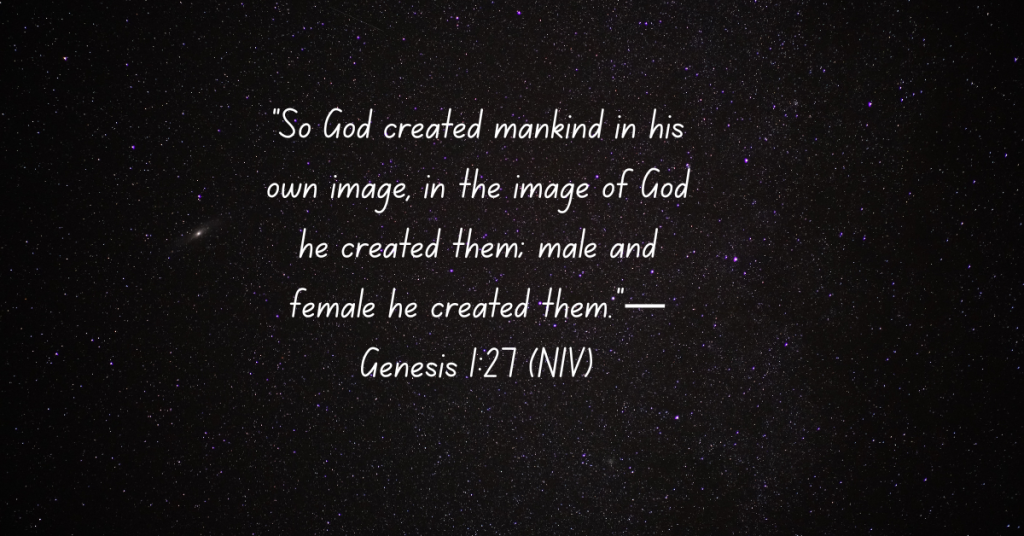
“So God created mankind in his own image, in the image of God he created them; male and female he created them.”— Genesis 1:27 (NIV)
What This Really Means
The Hebrew phrase here is tselem Elohim — the image or likeness of God. In the ancient world, kings would place statues of themselves in distant territories to represent their rule and presence. God did something far more personal: He placed living images of Himself — human beings — across the whole earth. Every single person carries this divine imprint.
This truth is central in Bible verses about human purpose, because it shows that human value is not earned, created, or improved — it is given by God Himself. Every person reflects something of the Creator, regardless of status, ability, or background.
This verse does not say you were made in the image of your productivity, reputation, social standing, or net worth. Those things can be stripped away in an afternoon. But what cannot be removed is the image of God in you. Your worth was established before your first success, before your first failure, and even before you were born. This is one of the deepest foundations found in Bible verses about human purpose.
Real-Life Application
The next time you measure your value by how others see you — your followers, your title, your income — pause and reflect. Ask yourself whether you are living as a reflection of God or as a reflection of culture’s definition of worth.
Bible verses about human purpose consistently challenge this mindset by shifting identity away from performance and back to creation. The challenge is not to think more highly of yourself, but to think more truthfully about who you are.
The Challenge It Poses
If every person is made in God’s image, how does that change the way you treat those you easily dismiss, ignore, or judge?
This is where Bible verses about human purpose become deeply practical — not just shaping belief, but reshaping behavior. Your purpose is not only about how you see yourself, but also how you see others.
Your Existence Is Not an Accident — and That Terrifies a Purposeless World

“For you created my inmost being; you knit me together in my mother’s womb. I praise you because I am fearfully and wonderfully made; your works are wonderful, I know that full well.”— Psalm 139:13–14 (NIV)
What This Really Means
The word translated “fearfully” here (Hebrew: yare) carries the sense of awe-inspiring reverence — as if the very process of your formation in the womb was something that caused wonder. David is saying that when God knit him together, the result was something worthy of being astonished by. Not just tolerated. Not just functional. Wonderful.
Think about what it means to be “knit” — it is not a factory process. It is intentional, patient, careful, artful. Your body, your mind, your temperament, your particular mix of strengths and sensitivities — they were not random outputs of biology alone. They were woven with intent.
This challenges the modern narrative that human beings are simply evolved animals whose purpose is self-defined. If you were crafted, then there is a Craftsman, and the Craftsman had something in mind when making you. Your quirks, your specific capacity for empathy or creativity or analytical thinking — these are not bugs. They are design features pointing toward your particular calling.
Real-Life Application
Write down three qualities about yourself you’ve always considered weaknesses or oddities. Now ask: what if these were specifically placed there for a purpose I haven’t yet discovered? This verse calls you to stop apologizing for how you were made and to start inquiring into why.
Purpose Precedes Birth — You Were Called Before You Could Choose
“Before I formed you in the womb I knew you, before you were born I set you apart; I appointed you as a prophet to the nations.”— Jeremiah 1:5 (NIV)
What This Really Means
This is one of the most disorienting verses in the entire Bible if you take it seriously. God tells Jeremiah that his calling was not the result of Jeremiah’s efforts, ambition, or spiritual performance. It was established before Jeremiah existed. Before he had a body. Before he could make a single choice. God’s words here span eternity and time in a single sentence: before I formed you and before you were born — two thresholds that felt ultimate to Jeremiah — and in both cases God says he already knew and already appointed.
This completely dismantles the idea that purpose is something you construct out of your desires and goals. The Bible’s model is not self-help. It is discovery. You are not building your purpose from scratch — you are uncovering what was already placed within you.
Real-Life Application
Spend time reflecting on what you keep returning to — the cause you can’t shake, the injustice that keeps bothering you, the gift others recognize in you even when you don’t. These recurring patterns may be the fingerprints of a calling that was set before you were born.
The Challenge It Poses
Are you building a life around what you want, or are you listening for what you were made to do? Those are not always the same thing — and this verse demands you know the difference.
You Are God’s Workmanship — Prepared in Advance for Works That Already Exist
“For we are God’s handiwork, created in Christ Jesus to do good works, which God prepared in advance for us to do.”— Ephesians 2:10 (NIV)
What This Really Means
The Greek word Paul uses here is poiema — from which we get the English word “poem.” You are God’s poem. His crafted expression. Not an afterthought. Not a rough draft. A finished work created with specific intent. And then Paul goes further: the good works you are supposed to do were not invented after your conversion. They were prepared in advance — laid out like a path before you even arrived.
This means purpose is less about invention and more about alignment. The works are already there, waiting. The question is whether you will walk toward them. Your life’s purpose is not for you to create from nothing — it is for you to step into what has already been designed.
Real-Life Application
Look around your current life — your neighborhood, your relationships, your community. Where are the needs that you, with your unique gifts and history, are uniquely positioned to meet? The “good works prepared in advance” are often hiding in plain sight, directly in front of you.
Your Ultimate Goal Is Not Happiness — It Is Transformation
“For those God foreknew he also predestined to be conformed to the image of his Son, that he might be the firstborn among many brothers and sisters.”— Romans 8:29 (NIV)
What This Really Means
The word “conformed” in Greek is symmorphos — to share the same form, to be shaped into the same mold. Paul is saying that God’s overarching purpose for every believer is not that they would be successful, comfortable, or even happy in the conventional sense. It is that they would be transformed into the likeness of Jesus Christ — in character, compassion, obedience, and love.
This is a direct challenge to the dominant cultural model of human purpose, which typically centers on self-actualization and personal fulfillment. The Bible’s model says that the self is not the destination. Christlikeness is the destination. And that process of being conformed requires the exact opposite of comfort: it requires suffering, surrender, refinement, and often the loss of things we have built our identity around.
Real-Life Application
When something painful happens — a failure, a loss, a difficult season — ask not just “when will this end?” but “what is this forming in me?” The challenges in your life are often the most direct route to your deepest purpose.
Your Body Is Not Your Own — and That Changes Everything About How You Live
“Do you not know that your bodies are temples of the Holy Spirit, who is in you, whom you have received from God? You are not your own; you were bought at a price. Therefore honor God with your bodies.”— 1 Corinthians 6:19–20 (NIV)
What This Really Means
In the ancient world, a temple was not a building people casually used. It was sacred space — set apart, carefully tended, reserved entirely for the presence and purposes of the deity it housed. Paul tells the Corinthian believers that their physical bodies now carry that same weight of sacredness. The Holy Spirit lives in you. That means your body — with all its physical habits, appetites, limitations, and capabilities — is the location of divine presence.
“You are not your own” is the part that most directly challenges modern culture, which insists relentlessly that your life is yours to do with as you wish. But if you were bought — redeemed at the cost of the cross — then the transaction has already happened. You have been purchased. And the purpose of your existence now includes being a vessel, a dwelling place, a living demonstration of God’s character in the world.
Real-Life Application
Consider your physical habits — how you use your time, your energy, your health. Are you stewarding your body as a temple, or treating it as a tool entirely for your own convenience? Honoring God with your body is one of the most concrete, daily expressions of your purpose.
You Were Created for God’s Glory — Not for Your Own Story
“Everyone who is called by my name, whom I created for my glory, whom I formed and made.”— Isaiah 43:7 (NIV)
What This Really Means
This is one of the most direct statements in Scripture about the reason for human existence. You were not created for self-fulfillment. You were not created for legacy, or success, or even happiness. You were created for God’s glory. This does not mean you are diminished — it means your existence has a reference point larger than yourself. Glory is not merely praise. In Hebrew, kavod refers to weight, substance, and splendor. God’s glory is his full character, made visible. Your purpose is to make that character visible through your life.
Real-Life Application
Ask yourself honestly: in the decisions I make and the way I live, am I pointing toward God, or am I pointing toward myself? This is not about religious performance. It is about whether your life reflects something beyond yourself — something that leaves others in awe of the One who made you.
The Challenge to Your Ambitions: What You Are Actually Called to Do
These nine verses confront the gap between what we pursue and what we were made to pursue — and that gap is often enormous.
The Entire Purpose of Human Life Fits in Two Commands — and You’re Probably Violating Both
“Jesus replied: ‘Love the Lord your God with all your heart and with all your soul and with all your mind.’ This is the first and greatest commandment. And the second is like it: ‘Love your neighbor as yourself.'”— Matthew 22:37–39 (NIV)
What This Really Means
When a lawyer asked Jesus to identify the greatest commandment in the Law, Jesus collapsed the entire Torah — 613 commandments in the Jewish tradition — into two. And the structure is significant: first, love God completely (heart, soul, mind — every dimension of human existence). Second, love your neighbor as yourself. Jesus says every other law and prophetic teaching hangs on these two. They are not merely the most important commands. They are the organizing principle that gives all other commands their meaning.
This directly challenges both religious and secular versions of purpose. The religious version tends to reduce purpose to private spiritual discipline — prayer, church attendance, personal holiness. The secular version reduces it to ambition, creativity, or contribution to society. Jesus insists that neither is sufficient alone. Love for God that ignores your neighbor is incomplete. Love for neighbor that does not flow from love for God becomes exhausted and self-righteous. Both dimensions, together, constitute the full human calling.
Real-Life Application
Map your typical week. How many hours go toward loving God — genuinely, not performatively? How many go toward serving your neighbors — the actual people around you, not an abstract idea of humanity? The gap between your current schedule and these two commands is the gap between your current life and your purpose.
The Challenge It Poses
If you had to honestly rate yourself on a scale of 1 to 10 on each command — love for God and love for neighbor — what would your scores be? And what would change if you took both seriously?
What God Requires Is Simpler — and Harder — Than Religion
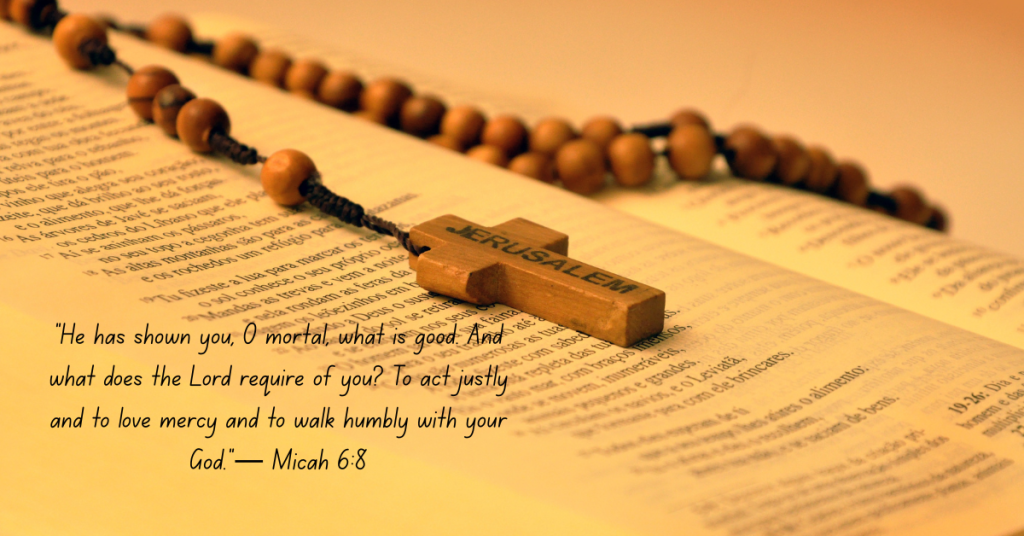
“He has shown you, O mortal, what is good. And what does the Lord require of you? To act justly and to love mercy and to walk humbly with your God.”— Micah 6:8 (NIV)
What This Really Means
Micah writes this in a context where Israel had become deeply religious but deeply unjust — performing rituals while exploiting the poor and ignoring the vulnerable. God responds with devastating clarity: you already know what is good. It has been shown to you. And what is required is not more ritual — it is three things: justice in action, mercy in attitude, and humility in relationship with God.
Act justly — this is behavioral. It is about your actual decisions, your business practices, your treatment of people with less power than you. Love mercy — this is attitudinal. You don’t just practice mercy reluctantly when required; you love it. You are drawn to it. Walk humbly — this is relational. It is a continuous, daily posture of depending on God rather than yourself. Together, these three form a complete picture of human purpose: just in your actions, merciful in your heart, humble before your Creator.
Real-Life Application
Is there someone in your life — an employee, a family member, someone who has less power in the relationship — whom you have treated unjustly? Is there someone who wronged you to whom you are withholding mercy? This verse cuts right through abstract theology to these specific, concrete situations.
The Great Commission: Your Purpose Extends Beyond Your Comfort Zone
“Therefore go and make disciples of all nations, baptizing them in the name of the Father and of the Son and of the Holy Spirit, and teaching them to obey everything I have commanded you.”— Matthew 28:19–20 (NIV)
What This Really Means
The Great Commission is perhaps the most expansive purpose statement in the New Testament. “All nations” in Greek is panta ta ethne — every ethnic group, every people group, every cultural community on earth. The commission is not to build a comfortable Christian community insulated from the world. It is to go into the world and make disciples — people who follow Jesus, who are baptized into the community of faith, and who are taught to obey his commands.
This challenges the deeply comfortable but deeply incomplete view of purpose that stays within the boundaries of personal spiritual growth. Discipleship is relational, costly, and directional — it moves outward, not inward. And the promise embedded in verse 20 (“I am with you always, to the very end of the age”) means this commission is not something you carry alone. The presence of Christ goes with you into every uncomfortable “nation” you are called to enter.
Real-Life Application
Who in your relational world is further from God than when they met you? A neighbor, a coworker, a family member? Your “nation” is often much closer than you think. Discipleship begins in the ordinary moments you are already living.
Ordinary Work Done for God Becomes Extraordinary Purpose
“Whatever you do, work at it with all your heart, as working for the Lord, not for human masters, since you know that you will receive an inheritance from the Lord as a reward. It is the Lord Christ you are serving.”— Colossians 3:23–24 (NIV)
What This Really Means
This verse was written to slaves — people at the absolute bottom of the social hierarchy, doing work they did not choose, for people who did not value them. And into that situation, Paul says: whatever you do, do it with all your heart, as if you are working for Jesus himself. This is not toxic positivity. It is a radical reframing of the entire category of “meaningful work.”
The implication for free people in the 21st century is even more powerful. You are not merely an employee or a business owner or a parent doing dishes. In every task, in every ordinary moment of labor, you have the capacity to orient that work toward God and transform its meaning entirely. Purpose is not confined to ministry, missions, or spiritual vocations. It is available in every moment of your life — if you bring the right orientation to it.
Real-Life Application
What is the most mundane task in your week? Now imagine doing it with the full knowledge that you are serving Christ in doing it. What would change — in your attitude, your quality, your presence? This is not a hypothetical. This is what this verse calls you to actually do.
Greater Gifts Mean Greater Accountability — Not Greater Entitlement
“But the one who does not know and does things deserving punishment will be beaten with few blows. From everyone who has been given much, much will be demanded; and from the one who has been entrusted with much, much more will be asked.”— Luke 12:48 (NIV)
What This Really Means
Jesus is speaking in a parable about servants who know their master’s will versus those who do not. But the principle he articulates in verse 48 has become one of the most universally recognized truths about responsibility: privilege creates obligation. If you have been given intelligence, resources, platform, education, talent, or opportunity that others have not, Jesus says you will be held to a higher standard of accountability for how you used them.
This completely dismantles the comfortable illusion that your gifts are simply for your enjoyment. They are not. They are entrusted to you — a word that implies a relationship, an expectation, and an eventual accounting. The person who buries their talent because they’re afraid of failure (see Matthew 25) is as accountable as the one who uses it destructively.
Real-Life Application
List three significant advantages you have had in life — educational, relational, financial, or gifted. Now honestly ask: are you using these in ways that could withstand divine scrutiny? Accountability to God is the most serious form of accountability there is.
Your Plans Are Not the Final Word
“Many are the plans in a person’s heart, but it is the Lord’s purpose that prevails.”— Proverbs 19:21 (NIV)
What This Really Means
This proverb is not fatalistic. It does not say your planning is useless. It says your plans are many — and they remain yours. But what ultimately prevails, what ultimately shapes the outcome of your life, is God’s purpose. This is both humbling and liberating. Humbling, because your strategies and goals are not sovereign. Liberating, because even your failures, redirections, and unexpected turns are not accidents outside of God’s oversight.
The challenge here is to hold your plans lightly while still making them. To plan well but remain genuinely open to being redirected. Many people discover their deepest purpose not in the plans they made, but in the unexpected detours that God allowed or arranged.
Real-Life Application
What plan in your life has recently fallen apart, been redirected, or been denied? Rather than interpreting that only as loss, ask what new direction God might be establishing in its place. The frustration of unmet plans is often the beginning of unexpected purpose.
Faith Without Action Is Dead — and So Is Purpose Without Practice
“In the same way, faith by itself, if it is not accompanied by action, is dead.”— James 2:17 (NIV)
What This Really Means
James is remarkably blunt. Claiming to believe in something while never acting on it is not faith — it is self-deception. The same logic applies to purpose. You can know your calling. You can articulate it with clarity. You can write it on your vision board or journal about it in beautiful language. But purpose that produces no action is not purpose — it is a pleasant idea. James’s word “dead” is deliberate and unsparing. A corpse has the form of a living body without the essential thing that makes it alive.
Real-Life Application
What is one thing you believe you are called to do that you have not yet taken a single concrete step toward? Today — not eventually, not when the timing is right — identify the smallest possible first action and take it. Purpose becomes real in the doing.
Your Gifts Are Not for You — They Are for Others
“Each of you should use whatever gift you have received to serve others, as faithful stewards of God’s grace in its various forms.”— 1 Peter 4:10 (NIV)
What This Really Means
Peter makes the direction of gifts unmistakable: they flow from you toward others, not inward for your own benefit. And the word “stewards” is significant. A steward does not own what they manage. They hold it on behalf of the owner, are responsible for its proper use, and will eventually give an account of their stewardship. Your gifts — whether they are musical, intellectual, organizational, relational, financial, or anything else — are God’s grace distributed through you into the world. You are the conduit, not the destination.
Real-Life Application
Think of your most developed gift or skill. Now ask: in the last month, how much of it went toward serving others versus advancing your own interests? This is not about guilt. It is about realignment — pointing your gifts in the direction they were designed to flow.
Discovering Your Purpose Requires a Renewed Mind — Not Just Changed Behavior
“Do not conform to the pattern of this world, but be transformed by the renewing of your mind. Then you will be able to test and approve what God’s will is — his good, pleasing and perfect will.”— Romans 12:2 (NIV)
What This Really Means
The Greek word for “transformed” here is metamorphoo — from which we get metamorphosis. It is the same root used for the Transfiguration of Christ. This is not behavioral modification. It is a fundamental restructuring of the mind itself — the way you think, the categories you use, the assumptions you hold about what is valuable, what is real, and what matters. Paul says this inward transformation is the precondition for being able to discern God’s will: his good, pleasing, and perfect will for your life.
In other words, you cannot accurately perceive your purpose while your mind is still shaped by the world’s patterns. Purpose clarity is the fruit of mind renewal. And mind renewal is a decision to daily expose your thinking to Scripture, prayer, and the community of faith — rather than the relentless formatting of cultural narratives.
Real-Life Application
What inputs are most shaping the way you think? Your social media feed? The news cycle? The opinions of people around you? This verse calls you to be intentional about the renewal of your mind — because what fills your mind determines what you are able to perceive about your calling.
Midpoint Reflection: Questions Worth Sitting With
- Based on the verses so far, is your current life pointed in the direction of your calling — or in the direction of your comfort?
- What assumption about your own worth needs to be challenged by these scriptures?
- Is your understanding of “success” compatible with God’s definition of a life well-lived?
- What gift are you currently using for yourself that was meant to serve others?
- What would change in your life this week if you took even one of these verses seriously?
The Challenge to Your Daily Life: How Purpose Is Actually Lived
Purpose is not a destination. It is a daily practice. These eight verses challenge how you live the ordinary hours of your existence.
Seek God’s Kingdom First — and Watch Everything Else Reorder Itself
“But seek first his kingdom and his righteousness, and all these things will be given to you as well.”— Matthew 6:33 (NIV)
What This Really Means
The context of this verse is Jesus’s teaching on anxiety. The people around him were anxious about food, clothing, and material security — the same basic anxieties that grip most people today. Jesus’s answer is not “don’t worry about those things.” It is to fundamentally reorder what you seek first. The kingdom of God refers to the realm where God’s rule is acknowledged and expressed — and seeking it means making the establishment of his authority and justice your primary pursuit.
The promise that follows is not that God gives you whatever you want. It is that when your priorities are correctly ordered, the things you genuinely need will be provided. The challenge is the ordering. Most people seek security, success, and comfort first and hope that faithfulness fits in somewhere. Jesus inverts this entirely.
Real-Life Application
What are the first three things you think about when you wake up? If none of them involve God’s kingdom or his righteousness, you have identified the exact reordering this verse is calling you toward. Purpose flows from priority.
After Testing Everything, Here Is What Matters
“Now all has been heard; here is the conclusion of the matter: Fear God and keep his commandments, for this is the duty of all mankind.”— Ecclesiastes 12:13 (NIV)
What This Really Means
Ecclesiastes is the most brutally honest book in the Bible. Its author — widely understood to be Solomon — has tested wisdom, pleasure, achievement, wealth, and philosophy, and declares all of it “vanity” (Hebrew: hebel, meaning vapor or mist). After that exhaustive inquiry, the conclusion is this: fear God and keep his commands. “Fear” here is not cowering terror — it is the awe-filled recognition of who God is and what that means for how you live.
Solomon is saying: I have chased everything culture tells you to chase. And here is what survives. Here is what endures when everything else dissolves. The person who builds their life on this conclusion will not be shaken when other things fall away.
Real-Life Application
If everything were stripped from your life — your achievements, your reputation, your comforts — would the foundation of your identity still hold? Ecclesiastes invites you to build on the only foundation that cannot be taken.
Freedom Is Not for Yourself — It Is for Others
“You, my brothers and sisters, were called to be free. But do not use your freedom to indulge the flesh; rather, serve one another humbly in love.”— Galatians 5:13 (NIV)
What This Really Means
The Galatian Christians had been freed from the slavery of the Law — from trying to earn God’s favor through religious performance. Paul affirms this freedom. But then he immediately redirects it: this freedom you have been given is not the freedom to live for yourself. It is the freedom to serve. Freedom from religious bondage becomes freedom for love. The old slavery to the Law is replaced not by autonomous self-expression, but by voluntary submission to others in love.
This directly challenges the modern definition of freedom, which is almost universally understood as the ability to do whatever you want. The Bible’s definition is the ability to do what God calls you to — which turns out to involve far more self-giving than self-assertion.
Real-Life Application
Where are you using your freedom — your time, your money, your choices — primarily for yourself? And where are you genuinely serving others? This verse invites you to audit your freedom and ask whether you are using it for what it was designed for.
Contentment Is a Skill, Not a Circumstance — and It Must Be Learned
“I am not saying this because I am in need, for I have learned to be content whatever the circumstances.”— Philippians 4:11 (NIV)
What This Really Means
Paul writes this from prison. He is not writing from a comfortable retreat about the theoretical virtue of contentment. He is writing from chains about a lived reality he has genuinely acquired. And the key word is “learned.” Contentment is not a personality trait some people are born with. It is a discipline, cultivated through experience of both abundance and need, that eventually produces a stability of soul independent of external circumstances.
This challenges the purpose-as-outcome model that says your life has meaning when things are going well. Paul insists that contentment — and therefore peace — can be present in circumstances of deprivation, failure, and loss, just as genuinely as in circumstances of blessing. Purpose is not a feeling produced by favorable circumstances. It is a rootedness that holds through unfavorable ones.
Real-Life Application
What circumstance are you most waiting to change before you can feel at peace with your life? This verse challenges you to begin practicing contentment now — in your actual, imperfect, current reality — rather than in the imagined future version of your life.
You Are Salt and Light — Not a Bystander
“You are the salt of the earth… You are the light of the world. A town built on a hill cannot be hidden.”— Matthew 5:13–14 (NIV)
What This Really Means
Jesus does not say “you could be” or “you should become.” He says “you are.” Present tense. Descriptive, not prescriptive. Before you have done anything, he declares that you are salt — something that preserves, flavors, purifies — and light — something that illuminates and makes hidden things visible. Your presence in any community, workplace, or family is meant to make it better, clearer, and more alive.
But salt that loses its saltiness is worthless. Light hidden under a bowl illuminates nothing. The danger Jesus warns against is not failure to be significant — it is the failure to actually function as what you already are. Passivity, conformity, and withdrawal from the world are not options for someone who understands their purpose.
Real-Life Application
In which areas of your life are you currently functioning as salt and light — making things better, clearer, more honest? And where are you hiding under a bowl, blending in, or going along with the decay around you? This verse calls you out of your comfort zone and into your community.
You Are an Ambassador — Which Means You Represent Someone Else
“We are therefore Christ’s ambassadors, as though God were making his appeal through us. We implore you on Christ’s behalf: Be reconciled to God.”— 2 Corinthians 5:20 (NIV)
What This Really Means
An ambassador does not speak for themselves. They speak for the nation they represent. Their words carry the weight of the government behind them. Paul says every believer holds this identity: you are an ambassador of Christ in whatever territory your life occupies. The appeal you carry is not your own message — it is God’s message of reconciliation. And “as though God were making his appeal through us” — the stakes could not be higher. People’s experience of God passes through your life.
Real-Life Application
How are you representing Christ in your workplace? Your neighborhood? Your family? Ambassadors are judged by how accurately they represent their government. You are being watched — not so you can perform for an audience, but because your life is someone else’s first or only encounter with the God you follow.
The Abundant Life Is Not What You Think It Is
“The thief comes only to steal and kill and destroy; I have come that they may have life, and have it to the full.”— John 10:10 (NIV)
What This Really Means
“Life to the full” — in Greek, zoe in perisson — is abundant, overflowing, exceeding life. This is not the affluent life that Western culture is selling. The abundant life Jesus speaks of encompasses meaning, connection, purpose, peace, the presence of God, and the fruit of the Spirit. It is a quality of existence that can coexist with poverty, illness, and hardship — as millions of Christians in persecuted contexts throughout history have demonstrated — but cannot exist alongside spiritual emptiness, even in conditions of material wealth.
The contrast with the thief is critical. The enemy of your soul seeks to reduce your life to consumption, performance, distraction, and ultimately meaninglessness. Jesus comes to give something qualitatively different: real, full, authentic, eternal life.
Real-Life Application
Are you experiencing life “to the full” — not in the prosperity gospel sense, but in the sense of deep meaning, genuine connection, and a soul at peace with its purpose? If not, this verse is Jesus’s direct invitation to a different kind of life.
To Find Your Life, You Must First Lose It
“For whoever wants to save their life will lose it, but whoever loses their life for me will find it.”— Matthew 16:25 (NIV)
What This Really Means
This is arguably Jesus’s most paradoxical teaching. The person who grips tightly to their life — protecting it, curating it, securing it, building it up for themselves — will ultimately lose the very thing they were trying to protect. But the person who releases their life — surrenders their agenda, their control, their self-constructed identity — for the sake of Jesus, will find it. Not lose it. Find it. As if the real version of your life was always waiting on the other side of surrender.
This is the deepest challenge in this entire list. Not because it is hard to understand, but because it is hard to actually do. The entire self-preservation instinct of human beings resists this teaching. And yet Jesus presents it as the central mechanism of purpose: you must give up the self-directed life to receive the God-directed one.
Real-Life Application
What are you gripping most tightly in your life right now — a plan, a relationship, a reputation, a version of yourself? This verse invites you to open your hands. Not because surrender is comfortable, but because it is the doorway to the life you were actually made for.
The Challenge of Eternity: Your Purpose Extends Beyond This Life
These final six verses place human purpose in its largest frame — the eternal perspective that changes everything about how you live now.
Without Faith, It Is Impossible to Please God — and Impossible to Fully Live
“And without faith it is impossible to please God, because anyone who comes to him must believe that he exists and that he rewards those who earnestly seek him.”— Hebrews 11:6 (NIV)
What This Really Means
The context of Hebrews 11 is the famous “faith hall of fame” — a list of Old Testament figures whose lives were marked by trust in God’s promises before those promises were fully visible. The author makes a sweeping claim: without faith, you cannot please God. This is not about perfect theology or flawless doctrine. It is about a fundamental orientation of trust — believing that God is real, that he is good, and that seeking him is worth it.
The phrase “earnestly seek him” implies intensity and persistence. Not casual spiritual curiosity, but a whole-hearted pursuit. This kind of faith-orientation is itself part of your purpose — not merely a prerequisite to purpose. To live seeking God earnestly is to live aligned with the deepest reason for your existence.
Real-Life Application
On a practical level: what does “earnestly seeking God” look like in your actual daily life — not in theory, but in your schedule, your habits, your decisions? If you can’t answer that specifically, you may have the concept of faith without the practice of it.
You Were Created for God’s Pleasure — Not Merely for Your Own
“You are worthy, our Lord and God, to receive glory and honor and power, for you created all things, and by your will they were created and have their being.”— Revelation 4:11 (NIV)
What This Really Means
This is the song of the twenty-four elders in the throne room of heaven. The reason they give for God’s worthiness is creation itself: he made all things, and by his will they exist and continue to exist. Your existence, moment by moment, is sustained by the active will of God. You did not come into being by accident. You do not continue in being by momentum alone. You exist because God wills you to exist. And the purpose implied in that reality is to respond to your Creator with the glory, honor, and acknowledgment he is due.
Real-Life Application
Spend five minutes today in deliberate worship — not as a religious exercise, but as a response to the reality that you exist by God’s will. Let gratitude for your very existence reorient your sense of purpose for the rest of your day.
Your Calling Is Holy and Was Given Before Time Began
“He has saved us and called us to a holy life — not because of anything we have done but because of his own purpose and grace. This grace was given us in Christ Jesus before the beginning of time.”— 2 Timothy 1:9 (NIV)
What This Really Means
“Before the beginning of time” — this phrase places your calling outside the timeline of history entirely. Before the universe existed. Before your parents were born. Before any human decision or action could have earned it. God determined to give you grace and call you to a holy life. The word “holy” (hagios) means set apart, dedicated to a particular purpose, consecrated. You were not saved to simply live a decent life. You were saved into a specific, sanctified calling that has been part of God’s eternal plan.
Real-Life Application
The fact that your calling predates your performance means you cannot earn it more or lose it through failure. But it also means you cannot ignore it. A calling this ancient and this deliberate deserves a response worthy of it. What response are you giving?
Three Commands That Define God’s Will for Every Moment of Your Life
“Rejoice always, pray continually, give thanks in all circumstances; for this is God’s will for you in Christ Jesus.”— 1 Thessalonians 5:16–18 (NIV)
What This Really Means
People spend enormous amounts of time and energy trying to discern God’s will for their lives — should I take this job, move to this city, pursue this relationship? Paul answers the “what is God’s will” question with disarming simplicity: rejoice always, pray continually, give thanks in all circumstances. These three practices are not just spiritual habits. They are the posture of a soul that has correctly understood its relationship to God and its place in the world. Rejoicing is not the absence of pain — it is the presence of a deeper reality that holds even through pain. Continual prayer is not constant verbal activity — it is a sustained awareness of God’s presence throughout every moment. Gratitude in all circumstances is not pretending that bad things are good — it is trusting that God is at work in all of them.
Real-Life Application
Before you look for God’s will in your major life decisions, examine these three: Are you genuinely rejoicing? Are you praying throughout your day, not just at set times? Are you finding things to thank God for even in your current difficulties? These are not small things. They are God’s revealed will for your life — right now.
Whether You Live or Die, You Belong to God — and That Changes Everything
“If we live, we live for the Lord; and if we die, we die for the Lord. So, whether we live or die, we belong to the Lord.”— Romans 14:8 (NIV)
What This Really Means
Paul is addressing a dispute in the Roman church about food and holy days. But in the midst of the argument, he lands on a truth so fundamental it transcends the specific context entirely. Whether you live or die, you belong to the Lord. Belonging — that is the word. Not performing. Not earning. Not achieving. Belonging. Your existence, from its first breath to its last, is in the hands of the One who made you, redeemed you, and holds you. And if that is true, then the anxiety that drives so many people’s frantic pursuit of purpose — the fear of meaninglessness, the terror of wasted time — is addressed at its root.
Real-Life Application
What would change in your relationship to fear — fear of death, fear of failure, fear of obscurity — if you genuinely believed that you belong to God? This is not a question for later. It is the question that determines how you live today.
Eternal Life Is Not a Destination — It Is a Relationship
“Now this is eternal life: that they know you, the only true God, and Jesus Christ, whom you have sent.”— John 17:3 (NIV)
What This Really Means
Jesus defines eternal life not as a location you go to after death, but as a relationship you enter — the knowledge of God and of Jesus Christ. The word “know” here is the Greek ginosko, which carries the sense of intimate, personal, experiential knowledge — not merely intellectual awareness. This is relational knowledge, the kind that grows through time spent together, through trust built and tested, through presence and communication.
This means eternal life is not merely future. It begins now. The moment you enter a genuine, growing, personal relationship with God through Jesus Christ, you have begun what will never end. And that relationship — not your achievements, not your reputation, not your legacy — is the deepest and most enduring expression of your human purpose. Everything else is secondary. This is what you were made for: to know God and to be known by him.
Real-Life Application
Is your relationship with God characterized by growing intimacy — a deepening knowledge of who he is, how he works, and how he loves? Or is it primarily doctrinal, transactional, or habitual? This verse calls you into something more alive, more personal, and more enduring than religion. It calls you into relationship.
The Final Challenge
If eternal life is knowing God, and this knowing begins now, what is your next step toward actually knowing him more deeply? Not attending more services. Not reading more theology. But genuinely encountering the living God. When will you take that step?
So, After All 30 Verses — What Now?
These thirty scriptures are not a complete catalog of everything the Bible says about human purpose. They are a representative sampling of its most challenging, most transformative, and most disorienting claims. Taken together, they paint a picture of human existence that is simultaneously humbling and astonishing: you were made in the image of God, called before time began, equipped with gifts to serve others, ambassadors of reconciliation in a fractured world, and destined for an eternal relationship with your Creator.
That is not the story the world is telling you. The world’s story is smaller, shorter, and ultimately emptier. It peaks at personal achievement and ends at death. God’s story begins before your birth and extends beyond your death — and your purpose, fully lived, participates in something that will outlast every empire, every trend, and every cultural moment you have ever lived through.
The question is not whether these verses are true. The question is whether you will live as though they are. That gap — between intellectual acknowledgment and embodied response — is where most people live most of their lives. You don’t have to stay there.
Pick one verse from this list. Just one. The one that challenged you most, disturbed you most, or stirred something in you that you haven’t been able to name. Sit with it this week. Pray it. Talk about it with someone. And let it begin to do what God’s Word was always designed to do: not inform your understanding, but transform your life.
A Prayer for Purpose, Clarity, and Courage
Before you close this page and return to your daily life, pause for a moment. This prayer is not religious decoration. It is an invitation to take what you have read and bring it before the God who authored every verse on this list — and who authored you.
Father,
I come before You with honesty. I have been living with questions about my purpose — sometimes quietly, sometimes with an ache I could not name. Today, these verses have forced me to look at those questions more directly than I am comfortable with. And I am grateful for that discomfort, because I believe You are in it.
Forgive me for the times I have measured my worth by what I produce rather than by whose image I bear. Forgive me for the times I have used my freedom for myself alone, when it was given to me for others. Forgive me for the plans I have clung to so tightly that I had no hands left open to receive what You were offering.
I want to know You — not as a concept, not as a distant authority, but the way John 17:3 describes: knowing You as eternal life itself. I want the knowing to be real, growing, and daily.
Give me the courage to surrender the version of my life I have been building for myself, and to step into the one You prepared for me before time began. Give me eyes to see the “good works prepared in advance” that are already waiting in front of me — in my family, my workplace, my neighborhood, my daily ordinary life.
Renew my mind, as Romans 12:2 commands. Reshape the way I think about value, success, legacy, and time. Let me see people the way You see them — as image-bearers of infinite worth. Let me see my gifts not as possessions but as stewardships, to be given away in service to others.
When I feel purposeless, remind me that I was knit together with intention. When I feel unqualified, remind me that my calling was established before I could have earned it. When I feel afraid to lose my life for Your sake, remind me of the promise — that the one who loses their life for You will find it.
I do not need to see the whole road. I just need the next step. Show me that step today. And I will take it.
In the name of Jesus Christ — who is himself the way, the truth, and the life —
Amen.Take a moment in silence after this prayer. Not to rush to the next thing. Just to sit in the presence of the One who knows your name, knows your calling, and is not finished with you yet.
Related Resources
- Don’t Panic:20 Bible Verses for Finals Week Stress
- 37 bible verses for people tired of pretending they’re okay
- Are We Just Chemicals and Neurons? What the Bible Says About Consciousness
- When Your Mind Never Rests: Bible Verses for Digital Overload and Constant Noise
- Does Free Will Really Exist? 18 Powerful Bible Verses on Choice, Fate, and God’s Plan
- For accurate Bible references and deeper understanding, this post links to trusted Christian sources such as Bible Gateway.
Stay Connected
Receive daily Bible verses and encouragement to help your child grow in faith.
→ Subscribe Now for Free Daily Strength